Sunday, June 17, 2018

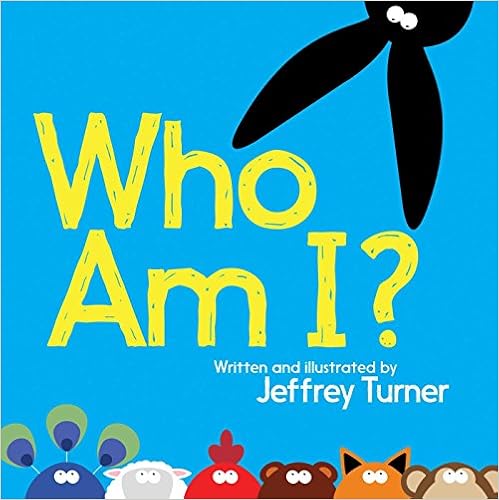
Who Am I?


Turner, J. (2017). Who Am I?. New York: Aladdin.
40 Pages, Grades Preschool-3, Fiction Picture Book, ISBN 978-4814-5304-2
The main character in this cute picture book is a rabbit, who always wants to pretend to be other animals. At first, the rabbit pretended to be a frog by putting a "frog facial makeup" on his face, but there was a voice reminding him that he was not a frog but a rabbit. However, he did not give up trying to pretend other animals. He then tried to be a rooster, a tiger, a mouse, an owl, a sheep, a monkey, and some other animals. Whoever he pretended to be, there was always a voice telling him he was a rabbit. He ended up accepting the reality of being a rabbit, and he started to wonder who "the voice" is. The book has a quite surprising and interesting ending, which is "the voice" pretends to be a dog as he is actually a bat.

The author of this book also illustrated this book. Overall, I think this is good children book that can be used as a teaching source in social studies class as teaching self-identity. Here are several good aspects of this book. First, the illustration of this book is very colorful, simple, and unique. The rabbit is always in the color of black throughout the whole book, which implies he could not recognize his self-identity. Next, I think the content of this book can be easily understood by even kids in preschool or kindergartener. Moreover, its creative ending can be a good teaching point for you to teach and guide students to think deeper about the concept behind the content. If you are teaching an integrating unit that integrates Language Arts, this book is also a good example of using talk bubble or speech bubble.  

Moth and Wasp, Soil and Ocean: Remembering Chinese Scientist Pu Zhelong's Work for Sustainable Farming


Schmalzer, S. (2018). Moth and Wasp, Soil and Ocean: Remembering Chinese Scientist Pu Zhelong's Work for Sustainable Farming (1st ed.). Tilbury House.
40 Pages, Grades 3-7, Picture book/ Biography, ISBN 978-0884484042. 

How can science change our life and the environment that we live in? This book talks about how a village in China solved their bug problems to prevent their crops from being bitten with the help of the scientist Pu Zhelong as well as how a boy from this village followed Pu Zhelong's example and became a scientist. The villagers in the countryside lived their lives relying on farming. However, they encountered some bug problems that the insects ate their rice and lychees, which made the fruits were very scrawny. They tried to use lights and chemicals to kill all the bugs, but the bugs appeared again after a while. Pu Zhelong came to the village used scientific methods that he had learned aboard to help them solve the problem. A boy witnessed what Pu Zhelong did and decided to receive higher education and the knowledge of science to help more people. 

I enjoy reading this book a lot for several reasons. First, the messages that this book is trying to express to the readers are positive and meaningful. It introduces how Chinese farmers' life looked like back in the last century as well as some common perspectives on Chinese culture. It involves one of the great work that scientist Pu Zhelong has done in his life to help and serve others. It also reveals that science can solve environmental problems and even change people's life. This book will be good for elementary kids to read when they are learning social studies about Chinese culture, people with outstanding contributions, farming, and the environment. The author uses the view of a boy from the village to write the whole story. It is easier to draw kids into the story and understand what the story talks about. Additionally, the texts of each page are always gathered together and on one side of the page, which helps readers read the texts more conveniently. For the illustration of this book, the illustrator uses flashbacks, multiple layers, and line-and-color wash illustrations to reveal the realistic images to the readers. You can notice that there are a lot of Chinese elements in the illustrations as you read this book. For example, there are different images of window paper-cutting on most of the pages, and window paper-cutting is one of the Chinese traditional crafts. Furthermore, there is no concrete stereotype of Chinese culture or other controversial issues in this book. If you are looking for a great book for social studies, you should definitely check this book out!

Reviewed by Liu, Yulin.

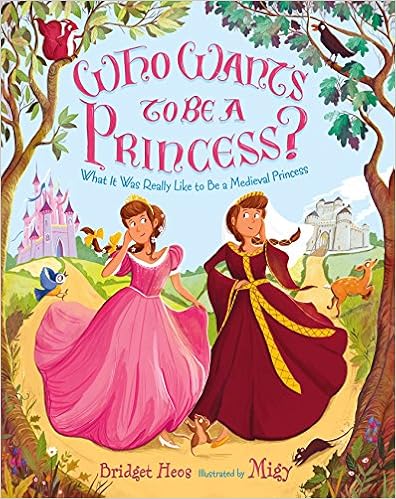
Who wants to be a Princess?


Heos B., ( 2017). Who wants to be a Princess?: New York, NY: Henry Holt and company. 36 pages,  Grade 2-3 history/ Nonfiction, 9780805097696.

      Beatrice was a real  Princess from the middle age. She told her story comparing fairy tales Princess lifestyle and her own. Beatrice basically explained the difference between a fairy tale princess and her own castle. She then continues to talk about the kind of room she lives and what might be a fairytale princess. Beatrice talks about a princess might wear a pink gown but what she wore was just itchy wool. She went on to explain the different lifestyle, for instance, a fairytale princess might live in her pink room alone but Beatrice lives with her siblings in their one room. A princess might sing to birds in the forest but Beatrice practices her riding on horse and archery. The Beatrice parents came back and they had a big feast. In the fairytale, a prince charming might come to rescue her from the castle but take her as his bride but for Beatrice, the parents will choose her husband even and they will get married even if they do not know or might not like each other. When Beatrice is scared her older sister will come and read her bedtime story.


       I like the book a. The book is interesting to read especially about the facts about a real princess and what they do. It has some good information about a fairytale princess and a real princess from the middle age. I think this book is good for younger kids to be able to understand the differences between a real princess and a fairy tale princess. It is good for social studies to be able to tell the story of the lifestyle of a princess, the surrounds, and the people. It is also a good book for kids to understand the culture princess has to follow. It is a good history book to tell the olden days of which princess lives and even nowadays. I even love the illustration. The illustrations are so nice to see the left side of the fairy tale life and on the right the real princess life. I think the book is not too wordy which is good for kids to read or even teachers can read aloud in class. I think the book is really well put together.

Reviewed by: Emylyn Walter


Tuesday, June 12, 2018

This Is How We Do It: One Day in the Lives of Seven Kids from Around the World


This Is How We Do It: One Day in the Lives of Seven Kids from around the World


Lamothe, Matt. (2017). This Is How We Do It: One Day in the Lives of Seven Kids from Around the World. San Francisco, CA: Chronicle Books LLC.
52 Pages, Grades PreK-3, Picture/Biography, ISBN 978-1452150185.  

What would it be like to live in another country? What would you eat, where would you sleep, and where would you go to school?  This book sheds some light on the lives of seven children from different countries around the world.  It goes through their typical day from waking up, what they wear, eating, going to school, and much more.  Are some of these children like you? Do you have things in common with them? This book ends with a similar experience that all these children have in common which helps us to know that although we may live in different places and live very different lives, there are still things that can connect us.  

I really enjoyed this book.  I feel like any child would love to look at the pages and illustrations of the different countries that this book represents.  However, I felt that this book jumped around a lot.  I found it challenging to go through the book read about each culture individually and learn more about each.  I felt that there is too much information about each culture skewed throughout the book that it made it hard to follow.  I found myself reaching the end and forgetting what I had learned about any one particular culture because there were too many to focus on at once.  I think that it is a great idea and that focusing on one culture and story at a time would better suit learning than this format.  Other than that I felt that the book was very informative on the lifestyles of the children and their families in the cultures. 

Monday, June 11, 2018

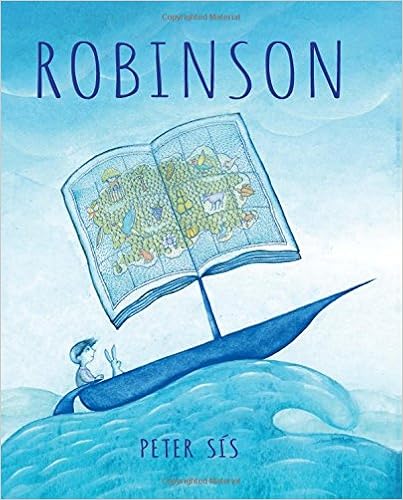
Robinson by Peter Sís

Sís, Peter. (2017). Robinson. New York: Scholastic Press.

48 Pages, Grades Preschool-3, Action/Adventure Picture Book, ISBN 0545731666

Robinson was written by Peter Sís and is based on a true story from his childhood.  The main character and the author's favorite story was Robinson Cruso by Daniel Defoe.  Both he and the main character went to the costume party at school dressed as Robinson Cruso from the help of their mothers; there all his friends laughed at him.  In the story the boy ventures out to an island and learns to survive and be brave there.  After which pirates come to his island home: his friends come to his room to apologize and learn about the adventurer Robinson Cruso, and he and his friends set out on their next adventure.  

There are several things that I like about this book and a few things that I didn't.  First of all, I like the messages entailed in this story: it's important to be unique and do things that you enjoy, it's important to not make fun of people, and it's important to apologize when you hurt some and to frankly forgive. Those messages truly relate to social studies because it's about social interactions and how you treat yourself and others.  This book is not historical or geographical, however it can be used as a supplemental text along with accurate texts for themes/topics that relate to exploration.  I do wish that the "adventure" to the island was more adventurous though, it seemed dull to me.  A fun language arts activity could be to read this book and read the author's note explaining the true events and have the students write an adventure story of their own based on their life.  Peter Sís was also the illustrator, and some pages I really loved the artwork and thought they would be great for a read aloud and others seemed too small, overly detailed, or boring.  The language used was plain; I would not use this text as an example of wondrous words or vivid verbs--rather I would have a writing activity for the kids to include more descriptive details and better diction for a third grade language arts lesson.  Overall if I had this book I think there are many great ways to use it, however, there are so many better books that take precedent over buying this book when it comes to my library.


Wednesday, June 6, 2018

Feather


Courgeon, R. (2017) Feather. (C.Z. Bedrick, Trans.) Brooklyn, New York: Enchanted Lion Books. 36 Pages, Grades PreK-4, Picture Book/Biography, ISBN: 978-1592702107


Paulina, the youngest and smallest girl in the family between her three older brothers and her father. Even though her name was Paulina they always called her Feather. Feather, love to play the piano ad being a girl. However, even though she was the only girl she always ended up doing all the chores of the house. One day after cooking dinner for the family her father noticed she had a black eye. Feather refused to reveal but at the end confessed she was quitting piano and was taking boxing. After several months of training the day came where Feather will have her first fight against a rough girl, Samira. When the fight finished Feather was not longer called Feather, she was Paulina. As the time passed Paulina never used her fighting gloves again. When people will ask her why she said, "Fists should be opened and fingers should fly."

Feather is a great book. The book has great illustrations and the story is very well explained. This book can be used for several topics in Social Studies. Identity, self-confidence, and gender equality are some of the topics that can be taught with this book. My favorite part of the book is that has a strong feminist message. The story can cause a big impact in our children by letting them know that men and women are the same and both have strong potential.

Monday, June 4, 2018

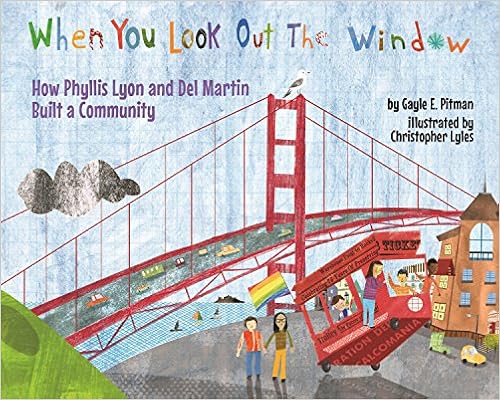
When You Look Out the Window


Pitman, G. E., (2017). When You Look Out the Window: How Phyllis Lyon and Del Martin Built a Community. Washington, DC: Magination Press.

40 Pages, Grades 2 - 3, Age 4 - 8 years old, Picture Book/Biography/Historical Fiction, ISBN: 978-1433827365

This book talks about Phyllis Lyon and Del Martin, who were one of the most famous lesbian couples in San Francisco. They were also very active politically in their time. They met each other in the year of 1950, and they became a couple afterward. They bought a house that is located at the top of the Castro; thus, they could overlook the entire city. The clue of the story in this book follows a tour of several different landmarks in San Francisco. Del and Phyllis went to each of the landmarks in this book and left their unique marks on each of them. One of an example would be the most well-known and iconic structure in the city, the Golden Gate Bridge. The story ends with a gratifying scene, which dedicates the community of big rainbow.

After reading the whole story, I do like some aspects of this book, but there are also some points I dislike about. First of all, I really appreciate the theme of this book, and I do believe this book can be used as a good Social Studies teaching source when you want to teach kids about LGBTQ history. I also like the illustration of this book, which is combined both drawing and photography on each page. IT stood out to me at the first time I read it. However, I had a question about the illustration of this book. I noticed there is a photo of a walking man on the several pages. I wonder if it has any secret meaning behind it. Another point that I do not like about this book is I think it did not really explain the process of how Phyllis Lyon and Del Martin build the community, even though the title of this book is When You Look Out the Window: How Phyllis Lyon and Del Martin Built a Community. I would not recommend kids to read this book on their own.