Sunday, June 3, 2018

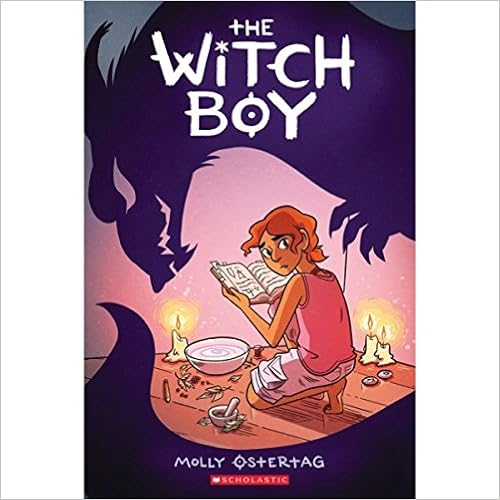
The Witch Boy


Ostertag Knox ( 2017). The Witch Boy: New York, NY: Scholastic Inc 224 pages, Grade 4-7, Graphic Novel / Non-Fiction, ISBN 9781338089516

Aster was a young boy who was always interested in learning witch magic. He would hide while the girls were taking witch lessons so he can take notes and learn. He would instead go to where the girls are at so that he would listen what they learn and continue to take notes. Aster would sometimes hide and practice the witch magic he learned from listening to the lady who taught the girls witch powers. The place where Aster lives do not allow boys to learn witch magic but only stick to learn shapeshifting which is to call the spirit and turn into a type of animal. While Aster wonders around, he found a new friend named Charlotte. One day the boys were out at night trying to call on the spirits, but months Aster was not able to shapeshift. One of Aster’s cousin disappeared and later appeared and acted differently. A red dragon seemed to Aster and told him about a deal to help him just like what he did to Aster’s cousins about shapeshift. Later, Aster found out some witch magic and spells with the help of his friend Charlotte. Mikasi was the red looking dragoon. He was a twin of Aster’s grandmother. He was basically just like Aster wanted to learn witch magic. Aster made the witch spell and the curse was broken from Mikasi. The family were surprised that it was the lost boy from long time ago. Soon after, the families agreed that there should not only be girls who can learn witch magic but boys too because Aster should them the magic he had from witch power.
I really like the book. It is very interesting. I think it is an excellent history of how girls were not the only witch from a long time ago. They were not the only ones who could possess the power. I think the book is suitable for maybe young kids from grade 4 to middle school. I think to teach it in class might not be necessary. I think maybe giving out a topic and the student can just learn it at home or even reading it in class but individual reading. I think it is not really social work relatable but it is in some ways especially talking about history and culture. The history of how the culture changes from only witch women to also men. I think the author did an excellent job with fewer words and pictures. The illustration is beautiful and very clear. I think kids would love to read this book. It is fun and exciting.

Reviewed by: Emylyn Walter

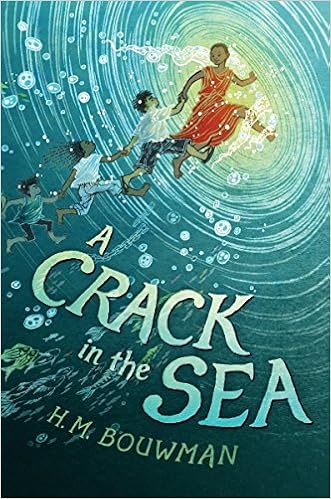
Bouwman, H. M. (2017). A Crack in the Sea. 375 Hudson Street, NY: G. P. Putman's sons, 357 pages, Grades 4-6, fiction, ISBN 9780399545191.

This book is a fiction that tells a story of specific children born with powers and unique skills. Pip's powers is the ability to speak to fish. His sister Kinchen does not have any powers however, she feels obligated to protect her brother from those who would misuse his powers. Some of these people include the Raft King. The King is on a mission to find a portal that will lead him and his people to their homeland. He kidnapped Pip and replace him with another child name caesar . Caesar has the ability of water but cannot talk with fishes. As Kinchen, Caesar and Ren (Kinchen and Pip's grandfather) are on their way to rescue Pip, Ren told a story about twins with magical powers whom were once sold as slavery with their uncle to an unknown land. These were the same twins plus refugees who escape the post war in Vietnam, and a sea monster came and join with Pip and his sister to their quest to finding a mystery land through a portal in the sea.

I personally love this book. I do recommend that we use this book in social study when introducing wars and slavery in the past. When the grandfather was telling the story about the powerful twins, I as a reader was able to see through the twins eyes what it felt like being sold as slave. It was told in detail how they saw people dying, how it smelt like dead people everywhere, and how the captain was throwing sick people off the ship so that they can collect the insurance money. These were actual things happening in the past. Though this may be a fiction story, it will help the student learn and see what it felt like being in a slave trade ship. Where people were treated unequal. This wasn't the only historical detail given in the story. There were children whom were trying to escape a postwar Vietnam, whom were weathering a ferocious storm, and escaping a  vicious pirate attack. Their stories are events that actually took place around the world in the past.

Saturday, June 2, 2018

Jang, J. (2017). Father’s Road. Grand Rapids, Michigan: Eerdmans Books for Young Readers. 36 pages, Grades 3-6, Fiction, ISBN 9780802854728.

This book tells the story of the narrators experiences through the silk road with his father. Through the journey, the narrator, Wong Chung, tells of different destinations they reach as well as landmarks. Wong Chung learns survival skills throughout the journey from his father, he also learns of why his father wants him to travel with him and why his father must make this journey. A perspective of the silk road and of the importance of trade is gained for the narrator.

This book was an interesting read but I do not think I would use it as the main point of a lesson. The stories and conversations told in the book are assumed to not be completely factual. This is because there was no reference to the narrator or where the information was gathered from. Although, it does give a good idea of what the silk road could be like and it would be great for imagination purposes but not for reference for content. The back of the book gives information about the silk road that can be used to support a lesson. In conclusion, I would use this book to help the students imagine traveling on the silk road but not for factual support to a lesson. Also, I think it is more appropriate for 4th grade because imagination is still an interest to this age group.

I Hug

McPhail, D. (2017). I Hug. Holiday House. 
32 Pages, Grades Preschool - 3, Picture book, ISBN: 978-0823438471

I Hug is illustrated and written by David McPhail, and it is one of the great picture books in the "I Like to Read" series. This book talks about one little girl named Zabella likes to hug all the wonderful things around her. She hugs her parents, her friends, her animals, her belongings, and nature. She enjoys giving a hug not only to human and other creatures but also to non-living things and objects that make her life happier and better. 

I absolutely love this children book in terms of its beautiful illustrations, simple texts, and positives ideas it reveals. It is a perfect picture book for beginning readers to read. First, McPhail uses watercolors to create all the scenes about a girl who loves to hug. Kids will love these soft illustrations and imagine they were the little girl in the book. Also, it is nice that either the illustrations fill a whole page or the images are emphasized by whitening the rest areas. For the texts that McPhail uses in the book, it is very appropriate to use familiar vocabulary and simple repetition because beginning readers can easily follow and understand the content. Furthermore, I hug reveals the key idea that everyone should be grateful for what we have and embrace everything in the world. The book also shares some shallow ideas about feelings and emotions, community, and the relationships with family, friends, and nature. I would recommend this book for beginning readers to read, and they will definitely enjoy it! 


Reviewed by Liu, Yulin. 

Nile Crossing

Beebe, K., & Comport, S. W. (2017). Nile Crossing. Grand Rapids, MI: Eardmans Books for Young Readers. 34 Pages, Grades PreK-3, Picture Book, ISBN: 978-0802854254  

Khepri, lives in Egypt alongside the Nile river. Kephri, along with his father takes time to go fishing. However, one day Kephri will not longer go fishing with his father. One morning, Kephri wakes up when the sun was not out yet and they together go and explore the Nilo as they arrived to Kephri's new adventure. But what could possible be better than fishing and  having fun with his father and five sisters? As they arrive to the city, Kephri and his father walk into a long courtyard. As his father says goodbye to Kephri, he remembers he is not alone because he has his mother's amulet and the Lord Kephri is on his side.

This is definitely an interesting book. I love how well the pictures and drawings have details about Egyptian culture. This book could be a great resource for some areas of Social Studies. This book can help some geography lessons to talk about locations, rivers, continents, etc. Another great idea to use this book could be to teach about how ancient Egypt society worked and how different society is today. This book has potential. However, there are some things I still wonder about this book. At the end of the story there is not a complete end which could lead the reader to a different perspective. I do not know if this information is real. Where does the story comes from? Who is Kephri? It's a good book but I would do more research about it.

Thursday, May 31, 2018

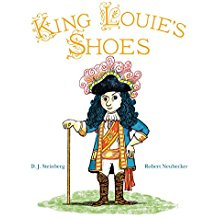
King Louie's Shoes


Steinberg, D. J., (2017). King Louie's Shoes. New York: Beach Lane Books.
48 Pages, Grades PreK-3, Picture Book/Biography/Historical Fiction, ISBN: 978-1481426572

King Louie the 14th had the biggest and largest of everything. He had the biggest palace, army, parties and gave the largest gifts.  However, there was one small exception- he was five feet and four inches short.  King Louie was committed to changing this and ordered larger everything a higher throne, larger wig, and a bigger pair of shoes.  None of these seem are working until he realizes that his people saw him as the great king he was no matter his height. 

I love this book and think it would be great for social studies.  This book would be a great book to use while talking about government and power because it emphasizes the fact that size doesn’t matter.  You can still make a difference even if you are small in stature.  I like how the book talks about image and how we try to change what we look like because we are insecure.  This book talks about how even King Louie felt insecure but then realized that image doesn’t matter as much as what you do in your life. 

Reviewed by: Serena R.

Monday, May 28, 2018

Out of Wonder: Poems Celebrating Poets

 
Alexander, K., Colderley, C., Wentworth, M., & Holmes, E. (2017). Out of Wonder: Poems Celebrating Poets.  Somerville, MA: Candlewick Press.

56 Pages, Grades 3-7, Poetry Picture Book, ISBN 076368094X

Out of Wonder: Poems Celebrating Poets is exactly that--poems celebrating poets.  These poems were written by Kwame Alexander, Chris Colderley, and Marjory Wentworth in the style of the twenty poets being celebrated.  The Newbery Award winning author, Kwame Alexander, and her team, not only write like the writers that inspired them, they tell the celebrated poets' stories in another way, express their love of poetry, and encourage the readers to write poems, perhaps from the inspiration of some of the great poets.  Together, Kwame and her team commemorate poets like Langston Hughes, Maya Angelou, and Robert Frost.  In this book, there are celebrated poets from ancient times, the nineteenth century, the twentieth century, and contemporary time.  The book also provides information on each of these poets and the three celebrating them.  The information includes the awards they won, their style of writing, their inspiration, their contributions, and their famous works. In addition to the poems, the illustrations by Ekua Holmes also tell a story.  Through the use of mixed-media painted collages,  Ekua expresses a sense of wonder, and she earned the Coretta Scott King Award for her illustrations.

Out of Wonder: Poems Celebrating Poets is a wonderful ode to the twenty poets included, and the writing of the three authors is moving.  This book would be an excellent addition to any classroom, especially starting at upper elementary and even through high school.  This book has a variety of different styles of poetry.  I am a huge advocate for poems, but I was not as familiar with the vast majority of the poets being celebrated.  So, I was not able to fully appreciate the similitude of the authors' writing.  I recognize that there were many poets included who significantly influenced history, however, the poems included focused more on the poets themselves and the audience's sense of wonder than the history the poets portrayed.  That being said, I love this book for language arts; as for social studies I think it could be a wonderful mentor text for a project where the students write poems from the perspective of historical figures or contemporary figures.  In addition, I love the mixed-media collages and will use this book as a mentor for the artwork, as well.